
Outdoor pellet stove care: preventing rust, touching up with heat-resistant paint and winter storage

An outdoor pellet stove spends the whole season outside: rain, morning dew, temperature swings and, after summer, frost. The question we get most often is not how to light it, but how to keep it looking good after two or three seasons. Rust spots on the base plate, a dull patch on the frame, a discoloured top edge — nearly always caused by moisture sitting on the steel for too long, not by the heat of the fire.
This guide explains what weather-resistant really means for an outdoor heater, which routine prevents rust, when to touch up metal with heat-resistant paint, and how to store the stove over winter. Every number here comes from our own product and maintenance specifications, not from general assumptions.
Contents
- Weather-resistant outdoor pellet stove: what does it actually mean?
- Can an outdoor pellet stove stay outside all year?
- Preventing rust on an outdoor pellet stove: the routine after every evening
- Heat-resistant paint for pellet stoves: when and how to touch up?
- Outdoor pellet stove cover: which size fits which model?
- Outdoor pellet stove winter storage in six steps
- Outdoor pellet stove maintenance: what not to do
- Frequently asked questions about outdoor pellet stove maintenance
Weather-resistant outdoor pellet stove: what does it actually mean?
Weather-resistant means the stove is built to stand and burn outdoors. It does not mean the material is untouchable. The frames of our models are steel with a heat-resistant powder coating: that layer protects the metal against heat, moisture and changing weather. What it cannot do is hold back moisture that sits in the same spot for weeks.
The product pages for the Flare and Lumina state it plainly: prolonged exposure to rain and moisture can affect the appearance of the product, which is why we advise storing the stove dry with a protective cover after use. That advice is not fine print — it is the difference between a stove that still looks sharp after three seasons and one with rust edges along the seams.
The vulnerable areas are always the same, wherever water can sit:
- The base plate and adjustable feet, where rainwater does not drain off but stays as a thin film.
- The top edge around the glass, where the coating takes the most heat.
- The ash tray: damp ash is more aggressive than dry ash because it attracts moisture and holds it against the steel.
- Seams, screw joints and corners, where a drop stays until it evaporates.
What we see most in practice is not material failure but a combination: ash left in the stove after use, followed by a week of rain. Together those two do more to the steel than a full season of intensive burning.
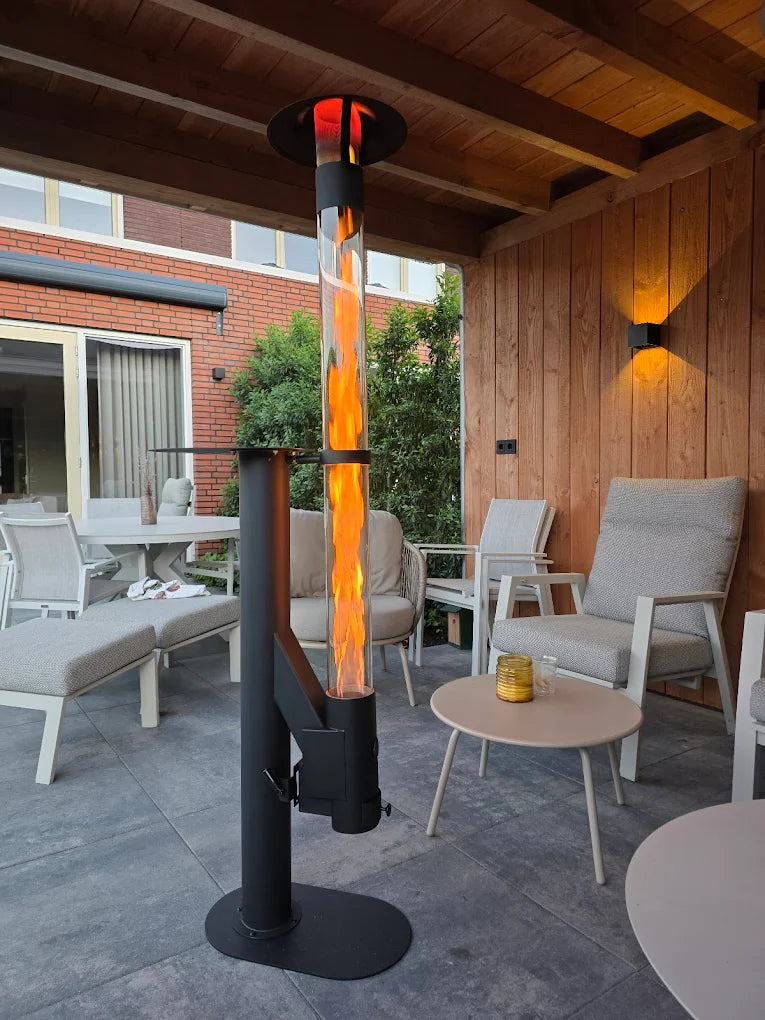
Customer photo: a covered spot cuts moisture exposure the most — a cover is still worth using.
Can an outdoor pellet stove stay outside all year?
Technically it can: the stove is built for outdoor use and a winter outside will not break it. We still do not recommend it. Our advice with every model is the same: after the season, store the stove dry — shed, garage or utility space — and use a protective cover. If it stays outside, cover it properly and leave no ash or moisture inside.
In practice, space is often the problem. On a balcony or a small city patio, moving it indoors is not an option. The order of preference is simple:
- Dry indoors (shed, garage, storage room) — best option.
- Covered outdoors with an outdoor pellet stove cover, for example under a canopy or veranda.
- Uncovered outdoors with a cover — possible, but check monthly that no water is trapped underneath.
That last step is the one people forget. A cover fitted over a wet stove seals the moisture in. Let the stove go completely cold and dry before covering it. We regularly hear this exact pattern from customers who notice marks on the frame: the cover was on, but it went on right after the fire went out.
For compact models like the Avara, moving it indoors is easiest — at 122 cm tall it fits most storage spaces. The Flare has wheels and a handle, so the trip to the shed takes little effort, once switched off and cooled down.
Preventing rust on an outdoor pellet stove: the routine after every evening
You prevent rust mainly by leaving the stove empty and dry after use. Five minutes of work after an evening beats one big clean per season. This is the routine we recommend:
- Let the stove burn out fully and cool down. Never move or cover it while warm.
- Empty the ash tray once the ash is cold — into a metal bucket or non-combustible container, never paper or plastic.
- Empty the pellet hopper if you will not be using it for more than a week. Pellets absorb moisture, swell and clump.
- Wipe the top edge and base plate dry after rain, or whenever the stove feels damp.
- Only cover once everything is dry and cold — and check underneath monthly.
Fuel matters too. Damp or contaminated pellets produce more ash and more residue, which means more dirt and moisture inside the stove. Burn clean pellets stored dry, with bags kept off the floor. For the quality requirements behind pellet certification, see ENplus, the international certification for wood pellets.
Surface rust is no reason to worry: it usually sits only in the top layer and can be touched up with an abrasive pad and heat-resistant paint. Where metal has corroded through or a joint seam is affected, do not paint over it — get in touch instead.
Heat-resistant paint for pellet stoves: when and how to touch up?
Touch up as soon as the coating goes locally dull, discoloured or lightly rusty — not once there is a large patch. Our heat-resistant spray paint is intended for metal parts of pellet stoves, barbecues, fire bowls and hearth plates that are not in direct contact with open flames. The product page specifications:
| Volume | 400 ml |
|---|---|
| Colour | Matt black |
| Temperature resistance | Up to approximately 800 °C |
| Substrates | Metal, cast iron, steel |
| Drying time | Touch-dry after approximately 10 to 15 minutes, depending on conditions |
| Use | Indoors and outdoors, in a well-ventilated environment |
The method in six steps:
- Pick a dry, low-wind day and work outdoors or in a well-ventilated space.
- Make the surface clean, dry and grease-free. This step decides the result.
- Sand off light rust until you reach sound metal. A primer is only needed on bare or lightly rusted metal.
- Shake the can for at least two minutes.
- Apply several thin coats from roughly 20 to 30 cm — thin coats adhere better than one thick coat.
- Respect drying times between coats and, where applicable, carry out the curing process per the instructions.
Two things to remember: never spray parts that sit directly in the flame, and never spray glass or the inside of the pellet hopper. If the glass is damaged or permanently clouded, paint is not the answer — replace the glass cylinder. All models and parts are in our outdoor pellet stoves collection.

Touch-ups only hold on a clean, dry, grease-free surface.
Outdoor pellet stove cover: which size fits which model?
The protective cover comes in four sizes. It protects against rain, dust and dirt, is suitable for outdoor use and is easy to fit and remove. These are the dimensions from the product page:
| Size | Dimensions | Suitable for, among others |
|---|---|---|
| Size 1 | 40 × 40 × 170 cm | Slim, tall models |
| Size 2 | 40 × 40 × 120 cm | Avara (122 cm tall, compact) |
| Size 3 | 70 × 70 × 115 cm | Wider, lower models |
| Size 4 | 70 × 70 × 178 cm | Flare and Lumina |
If you are between two sizes, take the one closest to your model. A little slack beats a cover stretched tight: pulled against the steel, the surface underneath dries more slowly. Tabletop models such as the Vulcan are simply carried inside.
An underrated benefit: with a cover you clean less and the stove is always ready to use. Under a canopy or veranda in particular, it stops dirt and moisture building up.

Only cover the stove when it is completely cold and dry.
Outdoor pellet stove winter storage in six steps
Winter storage takes half an hour once a year and prevents most of the damage we see in spring. Work through these six steps at the end of the season:
- Empty the ash tray and ash compartment fully. Leftover ash attracts moisture and holds it against the steel.
- Empty the pellet hopper and keep remaining pellets dry and off the floor.
- Clean the glass if there is residue — baked-on residue is harder to remove after a winter.
- Check the frame for rust spots and touch them up with heat-resistant paint before storing.
- Let everything dry completely, including under the base plate and around the feet.
- Store dry with the protective cover. If the stove has to stay outside, raise it so it does not stand in standing water.
Do not park the stove on wet concrete or on paving where water pools. A wooden batten or a slab under the base plate is enough to let the underside dry.
Outdoor pellet stove maintenance: what not to do
Some well-meant actions make things worse. These four are the most common:
- Covering while the stove is still warm or wet. You trap moisture, which is worse than no cover at all.
- Pressure-washing the seams. Water goes where it cannot drain: under the coating.
- Using ordinary lacquer or craft spray. Without temperature resistance it flakes off the hot parts.
- Leaving rust until spring. A winter of moisture on bare metal does more than the whole burning season before it.
And the key limit: paint is protection and cosmetics, not a structural repair. If a joint or seam has corroded through, or a load-bearing part or the glass is damaged, do not spray over it. Those parts get replaced — or send our customer service a photo first.
Frequently asked questions about outdoor pellet stove maintenance
Can an outdoor pellet stove stand in the rain?
Yes, the stove is built for outdoor use and a rain shower is not a problem. What we do not recommend is leaving it unprotected in the rain for months: prolonged exposure to moisture can affect the appearance of the steel. Store it dry with a protective cover after use, or at least cover it properly if it stays outside.
Why does a weather-resistant outdoor pellet stove still rust?
Rust is not caused by heat but by moisture standing in one place for a long time, often together with leftover ash that attracts water and holds it against the metal. The base plate, seams and the top edge around the glass show it first. Emptying, drying and covering helps more than polishing.
How much heat-resistant paint do I need for a pellet stove touch-up?
For rust spots and dull patches, one 400 ml can is more than enough. You work in several thin coats from roughly 20 to 30 cm, which uses less paint than one thick coat and gives an even matt black finish.
What temperature is heat-resistant paint rated for?
The heat-resistant paint withstands approximately 800 °C and is suitable for metal, cast iron and steel. Use it on metal parts that are not in direct contact with open flames. Work outdoors or in a well-ventilated space; a light odour can be released while spraying.
Do I need a primer on the stove first?
A primer is only needed on bare or lightly rusted metal. In all cases, clean and degrease thoroughly first. Without that preparation the paint adheres poorly and starts lifting again after a few evenings.
Can the pellet stove stay outside all year with a protective cover?
We advise storing it dry with the protective cover. If it does stay out all year, cover it properly, raise it so it is not standing in water, and check monthly that it is dry underneath. A cover over a wet stove works against you.
Which pellet stove cover size fits my model?
The protective cover comes in four sizes. Size 2 (40 × 40 × 120 cm) fits the compact Avara among others, size 4 (70 × 70 × 178 cm) fits the Flare and Lumina. If you are between two sizes, take the closer one; a little slack is better than stretched tight.


